
Hamnet by Maggie O’Farrell
It won’t come as a surprise to you that I normally prefer a book to its movie adaptation. 9.9999 times out of 10, I would choose the book version of a story over the cinematic one. There have been only a few occasions when I’ve felt the words on the page were truly honored on screen. A few of those examples include Harry Potter (all of them), Little Women (2019), and most recently, Hamnet (2025).
I first read Hamnet by Maggie O’Farrell in 2020, drawn in by the line just beneath the title: A Novel of the Plague. I remember ordering the book from my favorite bookstore, Browseabout Books in Rehoboth Beach, Delaware. The store was closed to the public but open for orders because of our very own plague—the COVID-19 pandemic.
Hamnet is a love story and a grief story, set in 1580s England during the time of the Black Death. It’s a deeply moving work of historical fiction based on Anne Hathaway, the wife of William Shakespeare, and their shared grief after a tragic loss. Although the great storyteller is a character in the book, he is never called Shakespeare. The emotional center of the story is Agnes—a wife, a healer, a mother.
When I saw that the film adaptation of Hamnet had been released in theaters, I shuddered. Not because I knew anything about it, I didn’t, but because this is what I always do when a favorite book is made into a movie. I’ve been disappointed too many times. Despite this, I did see Hamnet on the big screen, and I surprised myself by absolutely loving it.
The chemistry between Paul Mescal and Jessie Buckley draws the viewer in immediately, but it is Jessie Buckley’s portrayal of Agnes in her grief that is nothing short of extraordinary. She becomes Agnes, so consumed by loss, that I had to remind myself, over and over again, that I was watching a performance, not real life.
Knowing this, it should come as no surprise that Jessie Buckley took home the Oscar this past Sunday. In her acceptance speech, she was gracious and exuberant as always, but this time, on that enormous stage, she dedicated the award to “the beautiful chaos of a mother’s heart.” An Irish actress honoring motherhood on one of the world’s biggest stages felt especially fitting this week. I loved hearing her add, “Go raibh míle maith agaibh”—a thousand thanks to all—at the very end of her speech.
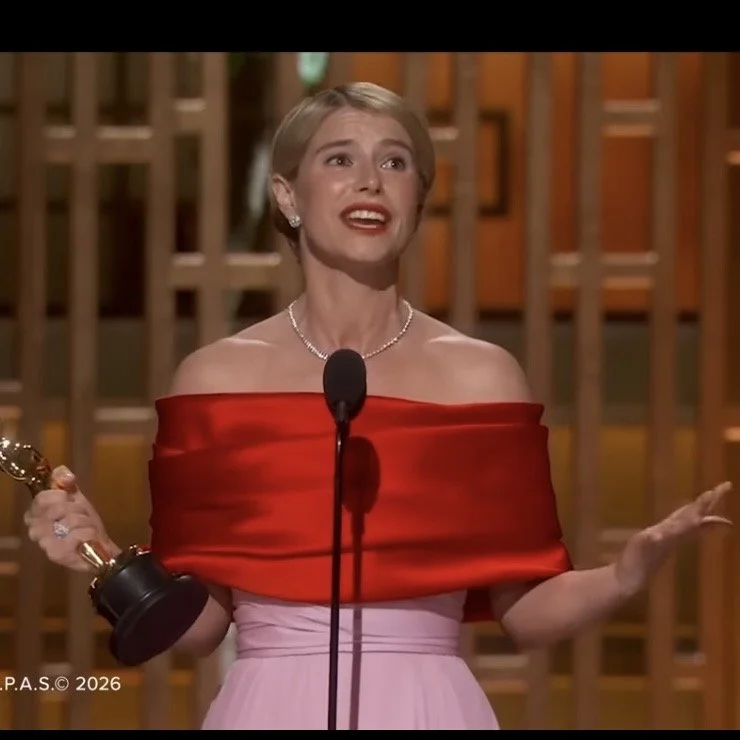
Jessie Buckley accepting Oscar for Hamnet
It’s a beautiful way to acknowledge that, at the heart of a story named for one of the best-known figures in literary history, is the love and devotion of a mother. I love these kinds of stories. I think of them as herstories—and I’m grateful to be living in a time when they are not only being written, but celebrated in novels like Hamnet.
If you haven’t yet experienced Hamnet, I recommend both wholeheartedly—start with the book (of course), and then, in this very rare case, go see the movie. It’s not often I say that, but this is one of those stories that somehow holds its power in both forms. Agnes will stay with you—on the page and on the screen—and you may find yourself thinking about her long after the final line or final scene. And for once, you might walk out of the theater thinking… they got it right.